
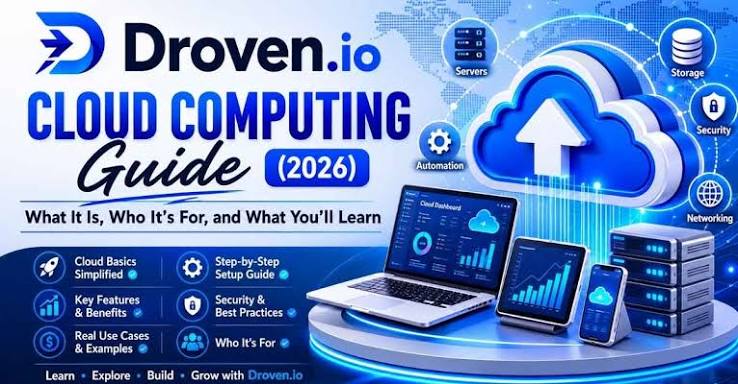
Cloud computing stopped being optional a long time ago. Whether you’re running a five-person startup or managing IT for a mid-sized company, chances are your data, your apps, and probably your entire workflow already live somewhere in the cloud. The problem is that most explanations of cloud computing are either too technical to be useful or too shallow to actually help you make a decision. That’s the gap the Droven.io cloud computing guide is built to fill.
This article walks through what the Droven.io cloud computing guide actually covers, why it’s worth your time, and how you can use it to build real understanding before you commit budget or resources to a cloud strategy.
What Is Droven.io? A Quick Introduction
Droven.io is an editorial knowledge platform focused on AI, automation, cybersecurity, and emerging technology, including cloud infrastructure. It doesn’t sell software, and it isn’t a marketplace pushing you toward a particular vendor. Instead, it functions more like a technology analyst — explaining what a concept is, where it fits, and what the tradeoffs are before you spend a dollar on it.
That distinction matters more than it might seem. A lot of the content floating around online about cloud computing comes from vendors with something to sell. Naturally, that content is going to lean toward whatever conclusion benefits the vendor. Droven.io positions itself differently, aiming to give readers a clearer, more neutral picture so they can make their own calls.
Understanding the Droven.io Cloud Computing Guide
The Droven.io cloud computing guide is essentially an educational resource built for people who need to understand cloud infrastructure without already being a systems architect. It’s aimed at business owners, developers, students, and IT professionals who want plain-language explanations rather than dense technical documentation.
Rather than assuming a technical background, the guide starts from the basics and builds up. It covers what cloud computing actually means, how it differs from traditional on-premise infrastructure, and why so many organizations have shifted toward it over the past decade. If you’ve ever nodded along in a meeting when someone mentioned “the cloud” without fully understanding what was being discussed, this is the kind of resource meant to close that gap.
Why Cloud Computing Knowledge Matters in 2026
It’s easy to assume everyone already understands cloud computing by now, but that’s not quite true. A lot of people know the term without understanding the mechanics behind it — how storage, computing power, and networking are delivered over the internet instead of through physical servers sitting in an office closet.
Here’s why that understanding actually matters:
- Cost control. Cloud services are often billed on usage, and without understanding how pricing works, it’s easy to overspend without realizing it.
- Security responsibility. Cloud providers handle some security tasks, but not all of them. Knowing where that line sits protects your business from gaps in coverage.
- Vendor decisions. Choosing between providers or service models without understanding the tradeoffs can lock you into a system that doesn’t fit your needs.
- Scalability planning. Businesses that understand cloud infrastructure can plan growth more realistically instead of scrambling when demand spikes.
None of this requires becoming an engineer. It just requires a working understanding, which is exactly what a resource like this aims to provide.
Key Topics Inside the Droven.io Cloud Computing Guide
The Droven.io cloud computing guide covers a fairly broad set of subjects, and understanding the scope helps you know what to expect before diving in. Generally, this kind of resource touches on:
- Core cloud computing concepts and terminology
- Deployment models (public, private, and hybrid cloud)
- Service models (IaaS, PaaS, and SaaS)
- Cloud security fundamentals and shared responsibility
- Cost management and pricing structures
- Migration strategies for moving off legacy systems
- How cloud infrastructure supports AI and automation workloads
That last point is worth pausing on. Cloud computing and AI are increasingly intertwined — most AI tools, from chatbots to predictive analytics platforms, run on cloud infrastructure behind the scenes. Understanding one without the other leaves a gap in the picture, which is part of why the Droven.io cloud computing guide often connects cloud topics back to automation and AI adoption.
Cloud Computing Basics Explained
Before getting into strategy, it helps to nail down a few foundational concepts. These come up constantly, and misunderstanding them tends to cause confusion down the line.
Service Models: IaaS, PaaS, and SaaS
Cloud services are generally grouped into three categories:
- IaaS (Infrastructure as a Service) gives you virtual servers, storage, and networking — the raw building blocks, without the physical hardware.
- PaaS (Platform as a Service) adds a development environment on top of that infrastructure, so teams can build and deploy applications without managing servers directly.
- SaaS (Software as a Service) is the most familiar version to everyday users — ready-made applications delivered over the internet, like email platforms or CRM tools.
Most businesses use a mix of all three, even if they don’t think about it in those terms.
Public, Private, and Hybrid Cloud
Deployment models describe where your cloud resources actually live:
- Public cloud resources are hosted by a third-party provider and shared across multiple customers.
- Private cloud resources are dedicated to a single organization, often for stricter security or compliance needs.
- Hybrid cloud blends both, letting sensitive workloads stay private while less critical operations run on public infrastructure.
There’s no universally “correct” choice here — it depends on your industry, your budget, and your compliance requirements.
How Businesses Can Use the Droven.io Cloud Computing Guide
The real value of a resource like the Droven.io cloud computing guide isn’t in memorizing definitions. It’s in using that understanding to ask better questions before making a decision. A business that understands the difference between IaaS and SaaS, for example, is far less likely to get oversold on a solution that doesn’t match its actual needs.
Practical ways to apply what you learn:
- Use it to prepare questions before vendor calls, so you’re not relying entirely on a salesperson’s framing.
- Reference it when evaluating whether to migrate legacy systems to the cloud.
- Use it to understand security responsibilities before assuming a provider “handles everything.”
- Bring it into internal discussions so technical and non-technical team members are working from the same baseline understanding.
This kind of groundwork tends to save both time and money later, especially for smaller teams that don’t have a dedicated cloud architect on staff.
Common Cloud Computing Challenges and How to Avoid Them
Even well-intentioned cloud adoption goes sideways sometimes. A few recurring issues come up often enough that they’re worth flagging directly.
Unexpected costs. Usage-based billing sounds simple until a spike in traffic or a misconfigured resource quietly drives up a bill. Setting usage alerts and reviewing invoices regularly helps catch this early.
Security misunderstandings. Cloud providers typically operate on a shared responsibility model — they secure the infrastructure, but you’re often responsible for configuring access controls, encryption, and permissions correctly. Assuming the provider “handles security” entirely is a common and costly mistake.
Vendor lock-in. Building everything around one provider’s proprietary tools can make it painful to switch later. It’s worth thinking about portability early, even if you don’t plan to switch anytime soon.
Poor migration planning. Moving systems to the cloud without a clear plan tends to create downtime, data issues, and frustrated teams. A phased migration, tested in stages, almost always outperforms a rushed one.
Getting Started: A Practical Cloud Computing Checklist
If you’re approaching cloud adoption for the first time, or reassessing an existing setup, a simple checklist can keep things grounded:
- Define what problem you’re actually trying to solve — cost, scalability, flexibility, or something else.
- Identify which workloads are sensitive enough to require private or hybrid deployment.
- Compare providers based on your specific use case, not just brand recognition.
- Map out a realistic budget, including the cost of unexpected usage spikes.
- Assign clear ownership for security configuration once you’re on a cloud platform.
- Plan migrations in phases rather than all at once.
None of these steps require deep technical expertise to think through — they just require slowing down long enough to plan intentionally, which is where a resource like this genuinely helps.
Conclusion
Cloud computing isn’t going away, and the businesses that understand it clearly tend to make better decisions than those chasing trends or vendor pitches. The Droven.io cloud computing guide exists to close that knowledge gap in plain language, without pushing a specific product or locking you into a sales funnel. Whether you’re just starting to explore cloud infrastructure or reassessing a setup that’s grown messy over time, spending a little time with a resource like this before making decisions tends to pay off. Understanding the basics now saves a lot of second-guessing later.
5. FAQ Section
Q1: What is the Droven.io cloud computing guide? It’s an educational resource that explains cloud computing concepts, deployment models, and service types in plain, non-technical language, aimed at helping readers understand the cloud before making infrastructure decisions.
Q2: Is Droven.io a cloud service provider? No. Droven.io is an editorial knowledge platform, not a software vendor or hosting provider. It explains and compares cloud concepts rather than selling cloud infrastructure directly.
Q3: Who should use the Droven.io cloud computing guide? It’s useful for business owners, developers, students, and IT professionals who want a clearer understanding of cloud computing without needing a technical background going in.
Q4: What’s the difference between IaaS, PaaS, and SaaS? IaaS provides raw infrastructure like servers and storage, PaaS adds a development platform on top of that infrastructure, and SaaS delivers fully built applications over the internet.
Q5: Do I need technical experience to understand cloud computing basics? Not necessarily. Core concepts like deployment models, service types, and cost structures can be understood without a coding or engineering background — that’s the gap this kind of guide is designed to close.
